Posted on
Posted in Energy Management

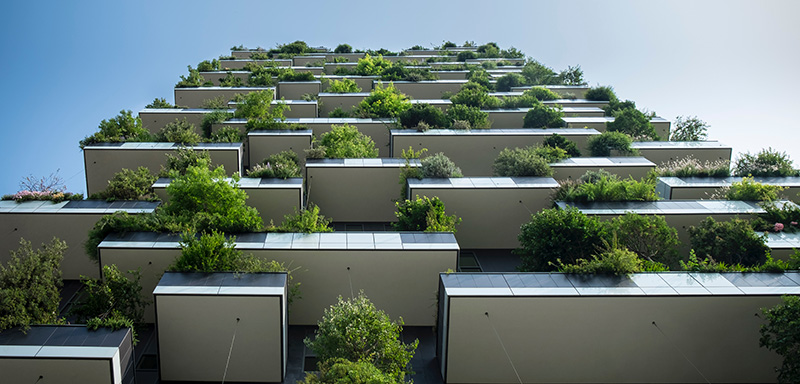
A commercial building or complex has an impact on the environment around it. When we choose to build “green,” we make a commitment to use available resources as efficiently as possible. The end result is buildings that are healthier for those inhabiting them while working in conjunction with the surrounding environment and provide cost savings.

Green Building Design

“green” building is a building that is sustainable. Its design will integrate seamlessly with the surrounding ecology through use of resource-efficient design specifics and equipment. Green buildings meet objectives such as promoting the health of the occupants, improving employee productivity and making efficient use of resources such as water, energy and other resources. A green building, whether being constructed from the ground up or renovated, is designed specifically to reduce its overall impact on the environment around it.

Features found in a green building

Green building and renovation practices will differ from locale to locale, depending on the surrounding environment. In general, most green buildings will feature one or more of the following design specifics:

  • Taking advantage of existing mass transit
  • Building materials make use of recycled content wherever possible
  • Retain natural land characteristics and protect existing natural features in the landscaping scheme
  • Landscaping choices will include plants that have low pesticide requirements and utilize water sparingly
  • Energy efficiency is a priority in all aspects of construction
  • Dimensional planning and utilizing material efficiency strategies
  • Include dual plumbing in the construction or renovation designs to allow recycled water use for toilet flushing. Investigate feasibility of a gray water system to recover rainwater and other non-potable water for use in irrigation systems
  • Improved air quality through construction materials and interior finish products that are zero or low emission
  • Adequate ventilation through things like an in-duct filtration system, and heating and cooling systems with proper ventilation and filtration

Going green carries economic benefits

The initial cost for constructing or renovating with green principles in mind may be higher than conventional construction methods, but the lower operating costs will generate savings over the life of the building. These cost savings cannot be fully realized unless included in a project’s original designs. This will require the input of an integrated team of professionals to ensure the building’s design reflects a single functioning unit rather than a collection of various systems that have no connections to each other.

The end result is savings for operating costs, lower maintenance expenditures, improved health of occupants and increased living comfort. Occupant and employee productivity can improve while reducing pollution.

Let our industry experts show you how to go green with your new projects and incorporate green principles in your renovations.

Posted on
Posted in Preventative Maintenance

With the uncertain economic climate, it is tempting to find creative ways to trim a budget. Cutting back on preventive maintenance is often an attractive target for reduction. However, skimping on this could end up costing you significantly more in the long term.

While it may appear that you are not seeing any return from your preventive maintenance dollars, you are enjoying real benefits with every action.

Cost Savings Maintenance
A well-maintained system functions at optimal performance. This means that it costs you less to run. Something as simple as dirty filters can strain your system, costing you more to operate it every day.

In addition to the ongoing operating cost benefits, having regular scheduled maintenance extends the lifetime of your systems. This means that you won’t have to invest in a replacement system until your current one has served you well for many years.

Conducting inspections as an integral part of a well-designed preventive maintenance plan allows technicians to identify issues before they become problems. Simple repairs and small part replacements can prevent a system crash which could force the need for purchasing a replacement system – a significant unexpected financial hardship on any business.

A hidden benefit from conducting inspections and maintenance is being notified when it is time to start planning for a more modern alternative to your current system. Technology is continually improving building environmental systems. While your present system is functioning properly, it may no longer be optimal given the latest available systems. A newer system could save you money in the long term. Being informed of your choices before you must make them gives you the time to budget for a cost saving replacement.

Posted on
Posted in Energy Management

Can your choice of lightbulb impact your company’s budget? Surprisingly, the answer is yes. While there are several options on the market, the LED lightbulb is the smartest investment choice.

Benefits of LED Lighting

Based on energy consumption alone, LED bulbs can help a company realize substantial savings versus traditional incandescent light bulbs and even compact fluorescent lights. Incandescent lights use almost 500 times as much energy as an equivalent LED light while CFLs use about 20% more energy than LEDs.

While it is true that LED lights are more expensive on a per unit basis, this cost is deceiving. During the life of a single LED bulb, you can expect to have to replace traditional bulbs at least ten times and CFL three. This makes the lifetime cost of the LED less expensive, in turn saving you money in the long run.

A hidden cost related to replacing bulbs is the expense of replacement. Having to replace lights less often leads to maintenance savings. Keeping a single replacement light on hand for an LED versus a shelf of backup bulbs for incandescent lighting saves inventory costs. Also, CFL bulbs contain hazardous materials requiring special disposal procedures, adding to their maintenance costs.

Another unseen impact is on your HVAC bill. Incandescent lights generate a lot of heat. CFLs, while cooler, still generate noticeable heat. LEDs are cool. Your facility’s lighting has a is a significant impact on your HVAC system simply from the number and type of lights in your facility.

The experts at Performance Solutions are happy to meet with you and develop a transition plan to reduce the sticker shock of switching to LED lights so you can start operating leaner and greener.

Posted on
Posted in Facility Budgeting

Developing an effective indoor air quality program at your school is key in maintaining a healthy environment. Mold and dust have the potential to cause a myriad of symptoms for those with sensitivities. According to CDCsome common symptoms include: nasal congestion, sore throats, coughing, wheezing, eye irritation, and skin irritation. People who have allergies to mold and dust are likely to have worsened symptoms. Infections may develop in those that have weak immune systems or lung conditions which can make for an extremely unproductive school environment and unhealthy staff members and students.

Developing Effective IAQ School Program
Poor air quality threatens the overall health of the school population; it also impacts the productivity and focus of those inside. When air quality is poor, concentration and energy levels are at risk of compromise.

According to EPA, “Good indoor air quality is essential for teacher and student health. Good design also produces more comfortable environments with proper lighting, air temperature, humidity and noise levels. This reduces distractions and creates environments where students and teachers can see clearly, hear accurately and not feel too warm or too cold.”

    1. Healthy and efficiently run school buildings improve health and productivity, resulting in higher achievement.  Money is saved in the long run due to lower operating costs. To get started on your school’s IAQ program, it will be helpful to refer to the indoor air quality tools for school action kit from the EPA to help build a framework for your school.


    1. Educating students and staff about how to maintain a healthy indoor environment is an investment in the health and success of schools. Try spending some time discussing little ways staff and students can help such as cleaning up messes (especially dust) and being careful about the type and amount of chemicals used in the building.


    1. Support from school leadership is necessary and may include contacting the school district or someone in charge of making decisions for your school.  Sharing this information may help them understand why it is important to develop a program in your school.


    1. Knowing your school’s history allows you to understand potential problems in the building that may need resolved.


    1. Creating a profile of the school’s current indoor air quality status allows you to obtain an accurate report of what needs improved.  This will also help to prevent future IAQ problems from re-surfacing.


    1. Walk the school with a professional to get an overview of conditions affecting indoor air quality so that you may create a checklist of issues that need addressed.


    1. Once you successfully launch an IAQ program, be sure to have a professional perform follow-up inspections regularly.

Contact us; We are here to help you from start to finish as you develop your school’s IAQ program.

Posted on
Posted in Energy Management

When we talk about energy, we tend to think of the immediate impacts of the choices we make. For example, fossil fuels are still fairly cheap, but they’re harmful to the environment. Solar and wind energy, while not currently able to step in and immediately replace these fossil fuels, are clearly a more acceptable, long-term solution.

What is Energy Sustainability?

Fostering energy efficiency in the long-term is referred to as energy sustainability.

What is Energy Sustainability?

When most people think of sustainable energy, they’re thinking of green energy-electricity produced from solar, wind, hydro-electric, tidal generation and other sources of naturally occurring power. That’s a piece of energy sustainability, but the most important aspect of an energy type to qualify is its sustainability. Or, its ability to be maintained at a certain rate or level.

Fossil fuels are not sustainable, for example, because there’s a finite amount of them. Even if it were possible to drill every well and mine every bit of coal without doing extreme damage to the environment, eventually, those resources simply run out.

Resources like wind or sunlight are different. While the wind does die down and the sun sets, those resources are infinite. Not only that, they are plentiful. The challenge is harnessing them in a way that is not harmful to the environment that will allow us to shrink our environmental footprint over the coming years.

Fortunately, though, that’s a challenge we seem to finally be meeting.

Posted on
Posted in Preventative Maintenance

Your temperature control system is something that hums away quietly in the background, keeping your building, hospital, or school comfortable, until a problem occurs. Your employees, clients, patients, and students count on you to keep their environment adequately heated and cooled. Disruptions to your Heating, Ventilating, and Air Conditioning (HVAC) systems can wreak havoc on your daily operations and utility costs. It is important to keep your equipment healthy and operating at its full potential.

Preventative Maintenance Tips for Temperature Control

Here are a few ways to prevent a total system breakdown:


    1. Scheduled Preventative Maintenance. Keep your HVAC systems running in tip-top condition by scheduling regular preventative maintenance. Servicing your systems will keep them running properly and efficiently for as long as possible. Preventative HVAC maintenance, like oil changes in your car, can prevent future problems with your system. These check-ups also make it possible to catch and repair minor problems before they become costly, major ones.


    1. Component Repair & Replacement. Even the most properly maintained system will have parts that wear out and need replacing. Necessary repairs and replacements on old, worn out equipment with new, high-quality parts will keep the system running seamlessly, avoiding a complete shut-down.


    1. Emergency Response Service. Breakdowns in your temperature control system seem to happen at the most inconvenient times. The heating system breaks down when it’s below zero or the air conditioning goes on strike during a heat wave. Have an emergency response service on speed-dial to get your system up and running again as quickly as possible.


    1. Customer Temperature Controls Training. Sub-optimal controls programming limit even the best systems. To help you get the most efficient and cost-effective use out of your system, BCS offers training tailored to your specific facility and HVAC system. You can be confident that your staff will know how to properly program your system.

At BCS, we understand that your HVAC system represents a significant investment in your facility. We know that a properly maintained and running system is essential for your operations. Let us be your partner in temperature control, so you can focus on your own priorities.

Posted on
Posted in Company News, Energy Management

What exactly does Performance Solutions offer and how can we help businesses? Facility and asset optimization programs are useful and are a necessity to keep your building running energy efficiently. Our team has an extensive process to not only assess and fix the root causes of facility issues, but also to ensure your operations succeed long-term.

How Performance Solutions Helps Your Business

Benefits of our Programs

  • First, we examine the past performance of your company’s facility operations.
  • Use mathematical models to examine aspects of your building and facility budget’s health- energy waste, mechanical equipment, operations costs, etc.

These assessments lead us to the root causes of immediate facility issues and more predictable operations management. They also allow us to provide:

  • Energy efficiency
  • Reduced energy bills
  • Reduced maintenance costs
  • Better communication between systems
  • Real-time building monitoring
  • Better decision making through data reporting

Our Solutions

Our comprehensive solutions work to make your everyday operations improved and painless, in turn improving your current systems and management practices.

This kind of money, energy and time savings is invaluable to a company. Contact us today and learn how Performance Solutions will help your business.

   
Posted on
Posted in Facility Budgeting

Another month, another utility bill. These ongoing costs can cause stress and busted budgets. While a necessary part of doing business, here are some simple things you can be doing to lower your facility costs.

Tips to Lower Utility Spend

    1. Take advantage of automated systems. Like programmable thermostats for your home, automated environmental control systems for your business can help you realize significant savings. An adjustment in temperature of a couple of degrees during non-business hours can see a significant impact to your utility bottom line.
    2. Map energy usage. Your utility control systems probably have information that you are not even aware of. An analysis of this data could reveal trouble spots that are costing you money. Ongoing monitoring of utility usage trends can spotlight issues before they reach a critical stage requiring costly emergency repairs.
    3. Regular maintenance and inspection. Your building systems work hard keeping your building comfortable year round. Periodic maintenance ensures that these systems continue to work as efficiently and cost effectively as possible. Furthermore, routine inspections are an ideal way to identify early stage issues so they can be dealt with quickly and economically.
    4. Invest in an upgrade. How does buying a new system help you save money? Your current system may function without a hitch, but depending its age could be costing you big every month by running inefficiently. Advances in technology have made today’s building systems more efficient and economical than ever before. Replacing an older system with a modern one can sometimes see a recouping of the investment in energy savings alone within two years. From that point on it is all savings.
    5. Develop a failover plan. While no one wants to imagine the worst. Failing to plan for system failure can cripple a company’s pocketbook. Emergency repairs or renting temporary equipment can be not only expensive, but disruptive to your business. However, a simple fallback plan could keep you operating through a crisis without bankrupting you.

The professionals at BCS can answer all your questions about these simple initiatives and how to implement them in your business. Start reaping the savings today.

Contact Us

Learn more about our services and offerings.

Service Requests

Our team is ready to assist. Please use one of the options below to submit your service request:

Warranty Claims

You can now submit warranty claims online via our fast and convenient online warranty process.

Become an Expert

Become an expert in building intelligence. Save money by lowering the total cost of ownership of your facility equipment. Sign up to receive helpful tips, tricks, and insights to facility management from people who’ve dealt with it all.

Become an Expert

Become an expert in building intelligence. Save money by lowering the total cost of ownership of your facility equipment. Sign up to receive helpful tips, tricks, and insights to facility management from people who’ve dealt with it all.