Posted on
Posted in Energy Management

Over the last few years there has been an abundance of discussion, debate, hype and confusion regarding the meaning and significance of “Internet of Things”, rather than rehash the past, I’d rather jump in and spend a few minutes talking about the future of the Internet of Things.  Throughout my career in technology I’ve found it extremely useful to look ahead and identify the obvious and not-so-obvious developments that are going to significantly change the path and pace of adoption by different market sectors and user segments.

Internet of Things is quite often described using examples of consumer goods and “things” that are in homes or cars, but I am frankly much more interested in the “things” that are found in places where we work, learn, meet, eat, shop and build.  The fact that most the innovations, development and early product launches have been in the consumer space is actually turning out to be quite beneficial because they (consumer IoT innovators) are beginning to solve the long list of challenges, hurdles and kinks that are inevitable in the emergence of any technology.

The potential for increased efficiency along with greater visibility and control that will be enabled by IoT for Commercial Buildings is my primary interest.  Right now, only a small percentage of all commercial buildings are truly being operated at optimal efficiency.  It takes months (or years) to find out dampers or valves are stuck.  It costs hundreds (or thousands) of dollars to send a skilled worker to a remote site to diagnose and cure something as simple as a loose wire.   Tenant complaints (and move outs) mount up while operations staff desperately tries to figure out how to make the building behave properly.

IoT innovations for buildings will likely reduce total cost of operations in our commercial and industrial spaces by 10 to 15%.  That’s conservative.  2016 has been a turning point for the pace of innovations being announced and released by the tech community.  IoT has been a “thing” for a long time, but we are really only just now seeing the tip of the ice-berg.

In an attempt to put the future of IoT into some relevant context, it’s important to point out that there is a long list of “things” that have already been successfully connected to the internet.  That’s not news.  But I like to point out that those things have several common attributes; they are expensive things, they have mostly all been invented in the last 15 years, they are things that need to be at least occasionally within six feet of a wall outlet, they are things that can afford to be paying a monthly data-plan and can run some version of unix (preferably with a Chrome Browser).

That list of attributes is a good place to start when thinking about the future of IoT.   Let’s pick a few of them apart, in no particular order:


Software

As you know, connecting a phone or a computer to the internet for the first time requires several deliberate steps involving multiple layers of software and tricky combinations of alpha-numeric keystrokes.  It has proven to be remarkably difficult to delete very many of the layers and steps needed to make a secure and reliable connection of a much simpler “thing” to that same internet.  Even if the “thing” has nothing more complicated to communicate than a temperature or humidity reading, the steps and layers are not much different than if that “thing” was trying to login into a Netflix account.

Companies like Google, SalesForce, as well as open-source communities are rapidly releasing IoT software development tools and platforms that allow things to connect and communicate with far fewer lines of code.  The significance cannot be overstated.   Fewer lines of code equates to a reduction in resources needed to make communications happen; less processor cycles, less memory, less time, less electricity, less heat.  The pace of future IoT development (more things get connected, sooner) is greatly enhanced by the reduction of code required for connections.


Communications

The future of IoT is highly dependent on advancements in cellular, wi-fi and blue-tooth radio technologies.  The physical realities of sending and receiving electronic signals is ridiculously complicated, but fundamentally comes down to the fact that there are a limited number of spectrum slices (channels) in which to arrange coordinated communication links.  Cellular connections hold the most promise, and we are beginning to see companies like Verizon wake up to the potential role they can play in the explosive growth of IoT.

In the last few months we’ve also seen the commercial release of chip-sets from Intel (and their competitors) that have 4G, 3G, Wifi, and BLE (blue-tooth-low-energy) all integrated with a processor and memory at a price point that will conceivable get under $20 (not yet, but soon).  These chip-sets were originally being designed to be the brains and radios for tablets, laptops and e-readers, but are now finding their way into the labs where street lights, chillers, and solar inverters are being designed.

Once the street light has it’s own stripped-down cell phone, it then will need to figure out how to read and sign the paperwork necessary to set up an account at the T-Mobile store.  I can’t wait to stand in line waiting for a HVAC system to decide whether to go with the 5gig or unlimited data-plan.  I won’t need to worry for long.  Rates and service options for connecting IoT devices to cell towers is a huge problem today, but is being solved by innovators like LynxSpring that are creating virtual and physically private networks using the towers that Verizon already has in place.

BLE and “beacon” technologies are also tremendously important and timely innovations that are coming to market (probably worth of an entire blog post by itself).  Simply put; product designers are beginning to see options for embedding secure internet communications functionality into more and more products and devices.


Power

Being weighed down by batteries or tethered to ac power source has been an unfortunate reality for anything that has wanted to transmit or receive internet protocols (especially wirelessly).  Ultra efficient processors, communication chips, and sensors are finally coming to market at prices that allow them to be considered for inclusion in more devices.

Battery technology evolution is frustratingly slow (just ask Elon Musk), but the billions of cell phone users that are seemingly all standing in line for that one open charging pole in LAX are driving significant investment in battery technology.  Energy harvesting technologies, and the re-emergence of DC power distribution systems will also eventually enable more IoT deployments.  I’m trying to be patient.

Interoperability

The battle for attention (market share) in the consumer technology IoT space is being dominated by companies that apparently have absolutely no intention of working peacefully with competitors.  Samsung, Google, Apple, LG and others have all adopted an all-or-nothing approach to marketing IoT products.  Each company has aggressively released a limited set of IoT products that are designed to entice consumers to become addicted to the rest of the limited set of IoT products that the vendor is offering.  IoT for commercial buildings will need to have standards and protocols that allow for multiple brands to work together in a system-of-systems type of environment.

While it is conceivable that a consumer may opt for an All-Samsung-House, or an All-Apple-Condo, it is almost impossible for me to believe that commercial building owners will ever settle for that sort of locked-in confinement.

API’s, pub-sub protocols, tagging schemes and coding languages are tilting toward open interoperability that wasn’t easy until now.  IoT products of the near-future can be built with a multi-brand, multi-vendor reality in mind.  Also important is the growing number of IoT software and platforms from companies like Yonomi and Initial State that allow orchestration and analysis of disparate devices from multiple brands.

Yes, the future of IoT is tremendously complicated.  Yes, the future of IoT will deliver extraordinary benefits.  And yes, we are just barely scratching the surface.  Stay tuned.

Posted on
Posted in Energy Management

When it comes to data, it is one thing to have access to it; it’s another to make it actionable.

Data Controls BoardWith more data available than ever before the industry is presented with a new challenge. Device data is stored and communicated in many different formats. It has inconsistent, non-standard naming conventions, and provides very limited descriptors to enable us to understand its meaning. Simply put, the operational data from smart devices and equipment systems lacks information to describe its own meaning. Without meaning, a time consuming manual effort is required before that data can be used effectively to generate value. The result is that the data from today’s devices, while technically “available”, is hard to use, thus limiting the ability for building operators to fully benefit from the value contained in the data.

Standardize what you call things. A multi-building campus with buildings built at different times with different contractors is likely to have multiple names and tags for similar pieces of equipment. You don’t want to end up with ten different names for air handlers or pumps. Multiple naming conventions in an existing building or portfolio of existing buildings is the largest and most time consuming issue involved with implementing an integrated building management system.

One naming convention to look at is Project Haystack (www.project-haystack.org).Project Haystack is open-source community utilizing tags and semantic data models to define and describe the meaning of data from smart devices of all types and enables software applications to automatically consume, analyze and present data from devices and equipment systems.

There’s no point in collecting inaccurate data. This is why Performance Solutions partnered with Lynxspring and Connexx Energy. To get the most accurate information you’ll need to ‘tune-up” the building systems and check the calibration of sensors and meters regularly. The building systems themselves should be regularly re-commissioned.

Data is a corporate asset and empowering companies to seek and make good fact-based decisions that drive better outcomes. Connecting to it; collecting it, storing it, insuring its integrity; analyzing it, and using it to make business decisions and develop strategy. Determining who controls and who owns the data and what is done with it will lead us down some interesting paths. Furthermore, as data velocity is on the rise, companies must be able to rapidly analyze it and get actionable advice instantaneously. It is not about more data, but rather asking the right questions to get the right data, understand it and help solve specific problems and address specific issues.

Marc Petock is Vice President, Marketing at Lynxspring and Connexx Energy where he leads corporate and product marketing strategy and execution, brand management, public relations and communications to support both companies strategic and growth initiatives. Marc is a contributing author, noted speaker and recognized industry leader having earned several industry accolades. Marc serves on the board of directors of Connexx Energy and Project Haystack; is an advisor to the Realcomm Organization and a Contributing Editor to Automatedbuildings.com.

Posted on
Posted in Energy Management

This past week Dave Mosby spoke as the keynote speaker at the kick off of

the Kansas Independent College Association’s Leadership Academy. Dave

shared with the emerging leaders 3 strategies to help them steer through

any emergency situation.

As a leader you need to be aware of the storms on the horizon and risks ahead. It is inevitable that you will experience a crisis at some point of your leadership. It’s your great responsibility to have thought through your process before something happens. What do you do when a crisis arises?  The key is to be prepared.

Here are Dave’s 3 strategies:

1. Fly the Plane

Stay calm and take a deep breath. Focus on your #1 job – whether it’s running your facilities or taking care of your staff. Many people have the tendency to try and solve the problem immediately, this is when other things get missed and the situation often worsens.

2. Analyze the Situation and Take the Proper Action

After you have kicked off your emergency process the next crucial piece is gathering information. The media, key stakeholders, or members of the community will come to you with many questions in a crisis. You need to organize your team and collect the data first. Once you have the data, you can communicate clearly the facts of the situation. This creates credibility and shows the strength of your team.

3. Land as Soon as Conditions Permit

Many think this should be the first step. In an emergency our gut says, “solve the situation” or “get that aircraft landed!” However, you don’t need to land; you can land later when everything is taken care of.  Follow your checklist and carry your process to execution. This is especially crucial in crisis since many people are watching your every move as if you were under a microscope. If you believe you have the solution run through the next steps with your team to ensure you will reach the desired outcome.

As a leader you have a really important job of investing in people. By knowing your assets you will be a leader that is prepared. You could encounter floods, fires, tornadoes, and even chandeliers crashing but by focusing on flying the plane, analyzing the situation and landing as soon as conditions permit you can steer through any emergency situation.

To see Dave’s full presentation, click here.

Posted on
Posted in Company News

BCS has turned 30! We have come a long way since Ken Stoppel and three HVAC colleagues started Building Controls and Services, Inc. (BCS) in 1985. From four employees to 100, BCS has changed a lot over the years. This growth was only made possible with the support and steadiness of our customers.

We love you. Each and every one of you. We would jump over backwards for you. As a company, we appreciate your patience and understanding as we continue to adapt, learn from our mistakes, and find better ways to serve you.

A company is nothing without the loyalty and dedication of its customers. On this milestone anniversary, we pause to celebrate the reason we have made it this far. You.

Thank You for 30 years of support and friendship. We are truly grateful and humbled by your trust.

Thank You for helping us celebrate you last week in the style of the decade that launched high scores, high hair and high quality services from BCS-the 80’s.

We hope you enjoyed the sweet stylings of 80’s cover band, The Astronauts, and the decade-inspired food and drink. If you took a trip “Back to the Future” and snapped a photo by the decked out time-machine DeLorean straight from the screen of the “Back to The Future” trilogy, those photos are available for download here. Enjoy!

You have enabled us to achieve more since 1985 than we ever dreamt possible. We hope you will continue to stand by us as we work together towards greater improvement. Cheers to 30 more successful years, we dedicate them to you! “Roads? Where we’re going, we don’t need roads.” Dr. Emmet Brown

Posted on
Posted in Ken’s Metaphors for Success

Our founder and CEO, Ken Stoppel, shares his experiences and advice.

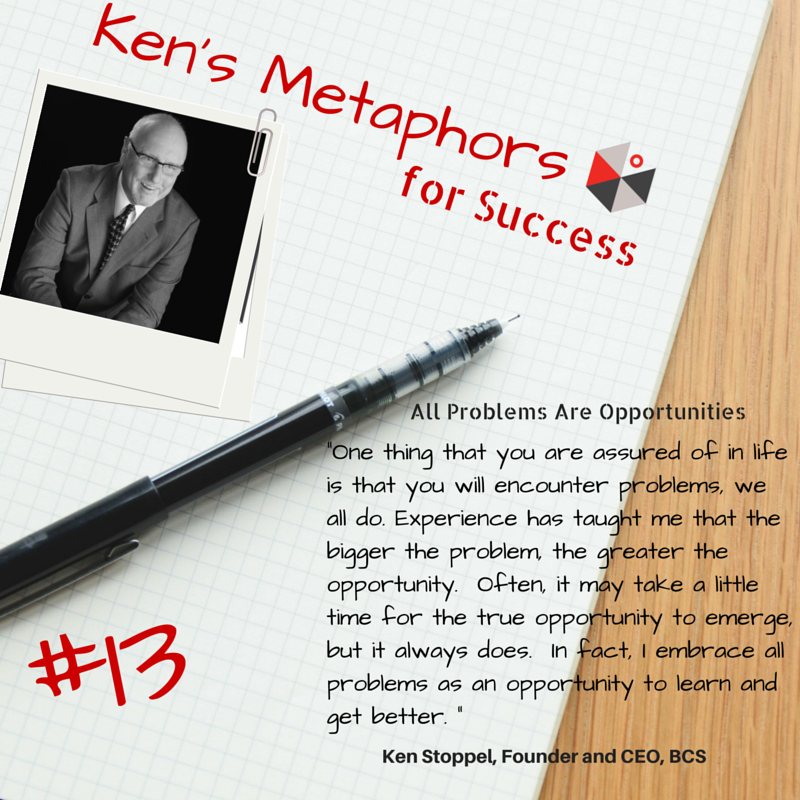
Here’s Ken’s Metaphors for Success #13:

Welcome adversity. It is the predecessor to wisdom. As I always say, “If learning from our mistakes is what makes us stronger and wiser, then I’m somewhere between Albert Einstein and Gandhi.”

One thing that you are assured of in life is that you will encounter problems, we all do. How you deal with them can be your key to either stress and turmoil or an opportunity to grow, move forward, and learn a valuable lesson. In fact, for years I had a sign in my office that said “Problems aRe Opportunities,” or simply “PRO”.

Experience has taught me that the bigger the problem, the greater the opportunity. Often, it may take a little time for the true opportunity to emerge, such as in a major crisis, but it always does. In fact, I embrace all problems as an opportunity to learn and get better. But, bear in mind, if the problem is of your own doing, and it repeats itself, that’s unacceptable.

Kens_Metaphors_13

Posted on
Posted in Energy Management

In the 21st century school there are ever changing regulations.

Data is used to make informed dec

isions on nearly all district matters: curriculum, hiring, onboarding, staff dismissal, professional development, and student services. What data is used for facility management and capital planning?

The Challenge

With demographics growing every year and facility purposes changing, it’s important to review facilities on a regular basis. However, many schools are working with a lean maintenance staff and a tight budget. This can create the perfect storm for remaining reactive, rather than becoming proactive about maintenance issues.

Where to Start?

Many firms believe replacing equipment to install newer technology is the first and best option. The alternative:  taking the time to analyze equipment is time intensive, and requires a unique set of skills. However, it is possible to take an approach where you first analyze equipment and prioritize what is critical to repair and then evaluate what needs to be replaced.

Taking a Closer Look

In order to know what recommendation to make for replacing and repairing equipment, a thorough walk through should occur. A few critical questions will arise:

  • What are the current district facility conditions?
  • What are the operational and energy costs?
  • Are the district buildings still being used for what they were originally intended?
  • Where are district facilities out of compliance?

This assessment creates a baseline and helps you understand the current state of your district facilities. With these data points, not only can you prioritize the issues, but also create a long term plan of how they will be funded.

Results

By taking a holistic approach to evaluate the needs of your district facilities, you can get ahead of deferred maintenance. Taking time to analyze equipment and make proper prioritization is a strategy that will lead to the best use of your district’s resources and lay the foundation for successful long term capital planning. Other benefits include:

  • Lessening the burden of potential downtime in critical campus buildings.
  • Reducing the number of emergency calls from teachers and staff to address comfort issues.
  • Producing ROI. With a baseline and goals, you can put metrics to the facility improvements. Showing ROI on facility improvements is something your School Board will understand and respect.

Click here to learn more about what we do and what makes our approach unique.

Posted on
Posted in Energy Management

Energy Efficiency RoundtableLast week Performance Solutions had the opportunity to participate in the Energy Efficiency Roundtable Event, hosted by the Kansas City Energy Project, Greater Kansas City Chamber of Commerce, and USGBC Central Plains.

Discussion was centered around an area we are passionate about:  how to optimize facilities for high performance. A few topics really hit home with participants and we had to share.

ROI

Seems pretty straightforward:  Return on investment. Not quite. When thinking of ROI, we look at it from a different perspective. The Performance Solutions team sees Return On Investment but also, Risk of Inaction.  If you ignore the signs of equipment starting to fail, you will experience serious downtime. For those operating critical or high traffic areas, this is not something to be taken lightly.

The Myth: A New Building Doesn’t Need Recalibration

Each group we met with asked this question: a new building doesn’t need to be recalibrated? To many participants’ surprise we discussed how a new building can be out of parameters in a matter of months from being built. We see this often during change of building ownership. Often the technicians involved in setting up the controls schedule leave the facility and new maintenance staff come in. Not knowing what was originally done, the schedules go unchanged month after month causing unnecessary equipment wear.

Recommissioning and Repairing VS. Replacing Equipment

The most common solution to deferred maintenance is to replace equipment. However, replacing equipment is costly and often times unnecessary. Many pieces of equipment have a life cycle of 20 years when repaired regularly. Our team highlighted the importance of understanding the current condition of all equipment and its life cycle cost management. For more information on how we dig into current operations read our article on Understanding Your True Cost of Operations.

Be sure to check out our Twitter account @BCS_PS more pictures and live updates on Performance Solutions!

Posted on
Posted in Company News

BCS received an AGC Award of Excellence at the 28th Annual State Building Awards for our contribution to Wichita’s iconic Exploration Place, a non-for-profit science center and museum. Thank you to our partners for helping us provide comfort zones to students and staff at exploration place: Central Air Conditioning Co., Dondlinger Constuction, SJCF Architecture and Midwest Engineering, Inc.

AGC Award of Excellence

Exploration Place established a need for more classroom space to accommodate its student summer program growth. Maintanence and HVAC issues related to the designed spaces arose. The equipment in the classrooms was outdated and not functioning properly. The unique shape of the building, limitations of the classroom space and lack of funding made this job particularly challenging.

In conjunction with LG, the entire project team donated time, labor and an LG VRF System to complete the necessary building rennovations. This project is a great example of owners, contractors, and suppliers working together to meet the owner’s needs despite major challenges.

See more about Exploration Place: https://bldgcontrols.com/exploration-place

Posted on
Posted in Ken’s Metaphors for Success

As the late Henry Ford once said, “If you think you can, or you can’t, you’re probably right”.  Never underestimate the power of optimism.  Anyone can find fault with something, or someone.  On the contrary, problem solving is one of the pillars of success.  Here’s Ken’s Metaphor for Success #12:

Have not only an eye for problems, but for solutions, as well

As a young Technician, initially, I found it quite easy to criticize the work of those before me.  As time passed, I realized that the real talent was in providing a solution.  As a manager, and ultimately an entrepreneur, nothing irked me more than when my Technicians were quick to point out how everything was wrong with something, usually tasks performed by others… and that a fix was “impossible” (an optimist’s most dreaded word). When you are discovering and identifying problems, never bother your boss without exhausting at least three attempts at a solution to resolve the problem, and NEVER use the word impossible.  Instead say, “It’s going to be tough, but here’s what we need to do”.

Ken's Metaphors

Posted on
Posted in Company News

Building Controls and Services would like to announce the addition of ClimateCraft to our HVAC product lines in Kansas, Western Missouri, and now in Northwestern Arkansas.

ClimateCraft.final logo 1024x114
ClimateCraft designs the industry’s highest quality, most durable and best performing Custom Air Handlers. Combining leading edge construction methods with high quality components and innovative design professionals, ClimateCraft creates custom solutions for the most challenging new construction, renovation, or replacementprojects.
ClimateCraft is focused on providing innovative, quiet, efficient, durable, space-appropriate solutions to the most difficult air handling challenges through a line of innovative products. Using unique production and installation methods, ClimateCraft’s ACCESS™, makes retrofits in small spaces with limited accessibility possible. Their revolutionary FlexSpeed™ motor is the next evolution of induction motor technology-a cost effective solution at premium efficiency. ClimateCraft BalanceStream™ technology improves fan array system efficiency at part load operation while reducing maintenance energy costs.

To find out more about these exclusive products, please contact our sales teams in both the Wichita and Kansas City offices.

Contact Us

Learn more about our services and offerings.

Service Requests

Our team is ready to assist. Please use one of the options below to submit your service request:

Warranty Claims

You can now submit warranty claims online via our fast and convenient online warranty process.

Become an Expert

Become an expert in building intelligence. Save money by lowering the total cost of ownership of your facility equipment. Sign up to receive helpful tips, tricks, and insights to facility management from people who’ve dealt with it all.

Become an Expert

Become an expert in building intelligence. Save money by lowering the total cost of ownership of your facility equipment. Sign up to receive helpful tips, tricks, and insights to facility management from people who’ve dealt with it all.