Posted on
Posted in Manufacturer News

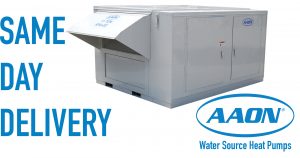
Ask us how you can enjoy same day shipping on AAON Water Source Heat Pumps through BCS. Partner with us for projects with tight turnarounds and WSHP replacements.

AAON has produced Water Source Rooftop Units, Vertical Self-Contained Units and Modular Air Handling Units with capacities ranging from 2-230 tons for 15 years. AAON Water Source Heat Pumps are the best option for replacing your current Water Sourced system, first, because of their double walled, foam cabinet construction which conserves energy and reduces costs. Secondly, the variable capacity compressors improve comfort and efficiency and third, AAON direct drive backward curved plenum fans offer improved efficiency, quieter operation, a smaller footprint and greater flexibility than others in the industry.

So, how does a Water Source Heat Pump work? Here’s how.

For same day delivery and support, contact us today!

WSHP Image Same Day Shipping Promo 1 300x158

Posted on
Posted in Energy Efficiency

leaking pipes
Droughts have an impact on everyday life for many people around the world. They can lower job availability and wages employees receive, as well as raise the prices for food products worldwide. With severe droughts, water efficiency becomes extremely important, especially for businesses, who play a big role when it comes to water conservation. Companies who rely on water for their products are the most influential when it comes to making water conservation a way of life. Here are the top 3 ways to improve water efficiency in your company.

    • When it comes time to start replacing fittings and equipment, the choice you make can change your utility bill for the better. Try to buy pressurized and water-efficient appliances, as well as efficient tap fittings. This can be more expensive at first, but they are an investment that will pay for themselves over time as your utility bills drop drastically.


    • Always keep an eye out for leaks. Some leaks will be obvious, and if you see faucets that drip or any other type of leak, get it fixed immediately. You should also keep an eye on your water bill. If your bill suddenly begins to rise, you may have a pipe leak or a leak somewhere in your building that you can’t see.


    • Educate your employees. This may seem simple, but it’s honestly the most efficient way to conserve water. Teach your employees to conserve water in their everyday jobs as a way of life in your company. Make sure no one leaves the water running while washing their hands or doing other tasks. You could also post water saving tips in bathrooms and kitchens with creative ways to conserve water. The more education you give employees, the more effective they will be.

There are plenty of ways to be more efficient in your water usage and lower your utility bills. These are just a few ideas that could have a large impact for any company. For more information on building analysis, please contact us.

Posted on
Posted in Energy Management

There are certain expenses we all accept as the cost of doing business. One of those common costs is our energy bill. While we can’t unplug our workplaces, we can take some steps to make sure we’re getting the most out of the energy we are using.

chargers plugged into wall outlet

Tip #1: Stop Vampire Energy

When you leave some devices plugged-in, even if they’re turned off, they’re still using power. For example, your phone charger is sucking energy from the socket to keep the power light on. Whenever possible, use a surge protector that you can shut off with a single flip of a switch. This also provides additional electricity protection for your devices.

Tip #2: Upgrade with an Eye Toward Efficiency

If you take a look around your workplace, there are all kinds of upgrades you could make. For example, are your lights still old-fashioned incandescent bulbs? Fluorescent or LED bulbs are more energy-efficient and longer lasting. Are your desktop computers old but serviceable workhorses? Chances are they’re guzzling electricity. Newer, sleeker models would use less power, and likely take up less space too. Everything from your water heater to your refrigerator should be evaluated and the cost of keeping it should be compared with the cost of upgrading.

Tip #3: Timers and Sensors are your Friends

Automating your workplace functions can save a great deal of energy. For example, a programmable thermostat can cut down on wasted energy, making sure the building isn’t overly heated or cooled when empty. Using sensors in place of light switches in closets, bathrooms, and other rooms reduces risk of leaving the lights on, cutting down considerably on energy use. If your building has exterior lights, sensors can trigger when the sun goes down, ensuring they won’t be left burning throughout the day.

For more tips on how you can increase your energy efficiency, contact us today!

Posted on
Posted in Life Safety Systems

asset protection and security system
Asset protection on a building identifies and effectively manages property, technological valuables, and open spaces in a building that needs protection. Asset protection solutions monitor and alert designated administrators once a particular asset or valuable leaves the building. Structures are put in place that ensure visitors and employees are safe while in the building at all times. Certain buildings require different levels of asset protection:

    • Perimeter Security –Walls and fences with an electric circuit are implemented to protect against a lurking intruder. Electric fences deter intruders from scaling the wall and jumping down into the building. With perimeter security, security guards may also be stationed on all access areas at the building’s entry gates.


    • Gate Entry System – This system works by monitoring people’s movement in and out of the building. All personnel must pass security clearance at the entrance gate before accessing the building. Permission is also granted only to specific areas of the building.


    • CCTV Camera System – CCTV cameras installed at strategic points can recognize movement and persons inside the building and can also capture vehicle registration. Administrators can link CCTV security systems with a mobile device for monitoring remotely.


    • Intruder Alarms – In asset protection, intruder alarms are vital, going off in case of intruders on the premises. Most intruder alarms sound a deafening alarm, deterring intruders from accessing the building.

These are only a handful of security solutions your company may consider implementing at your facility.  For more information on building security systems, please contact us.

Posted on
Posted in Energy Management

Going green isn’t just a public relations stunt. It’s a movement that reaps its own rewards for years to come. To help start the process, these four steps can help you strategize your plans towards becoming a greener company.

1. Do Your Research 

Before implementing a green initiative at your facility, make sure you understand everything that going green entails. Decide what initiatives are a good fit for your company to start with. Are there green programs that might require more time and money than your organization can commit now? Put those lower on your list. It’s a good idea to start with something easily actionable that will yield quick results and get people excited immediately. Then move to more difficult initiatives.

You’ll also want to check within your organization and see whether anyone else is already leading a green program. Partner with them if you can!

2. Evaluate Everything 

Green is a big business these days. Companies know they can make more money by including the word on their product or program. Make sure you look into every claim. Utilize the research you did in the first step to make sure you are investing your time and money in a truly green product.

3. Invest in Green Cleaning Supplies

Green cleaning is a great way to get people in your organization excited right away, especially with the growing number of individuals with chemical sensitivities. Just make sure that once again you evaluate every claim! Don’t spend money on cleaning supplies that claim they are green but really aren’t any better than the products you already use.

4. Run the Numbers 

You’ve done your research. You’ve found a green initiative to start on. Now it’s time to run the numbers of different service providers. With the amount of competition in the green movement, you should get a fair price. Going green shouldn’t cost big bucks.

At BCS Performance Solutions, we are committed to helping you realize the benefits of going green. For more information, contact us.

Posted on
Posted in Company News

construction handsEven the best sales people need new tricks and refreshers. Our Product Manager, Tom Tallon, has learned a thing or two from his last 29 years in the HVAC sales field. Here are some tips and tricks to seal the deal and nail the sale!

1. Listen first

Find out what the customer needs and wants before you start to “sell” them on your products. Make sure the solution you offer meets or exceeds the customer’s wants and needs and positions you nicely to introduced the benefits of your own products.

To get an accurate read, ask these questions during your initial conversation:

  • Are you concerned about the utility costs that you incur monthly while operating heating and cooling products?
  • Is warranty of the product a benefit that you would use in consideration for the product or purchase?
  • Is the efficiency of the unit a decision factor in which product you buy?
  • Is a low maintenance heating and cooling system important to you?

2. Schedule a visit

Once you’ve asked the important questions, schedule a visit with the potential customer. People don’t like appointments. An appointment is an obligation. If you “schedule a visit” with your customer, your meeting suddenly becomes more of a social, friendly get together where there is no pressure to purchase. Give the customer flexibility to pick the date and time that works best for them. Put two dates on the calendar- one as a contingency. This gives you an opportunity to follow-up with the customer to confirm which date works best before your visit. Leave the second date in your planner until you have attended and finished the first meeting.

Come prepared: Before the visit, ask for as much information as possible so you show up totally prepared. For example, ask who and how many people will be attending the consultation. That way, you bring the appropriate amount of information when you visit.

3. Create a good first impression

Dress for the call- don’t roll in off a job site with muddy boots and an untucked t-shirt. If you are going into someone’s home, dress cleanly and appropriately.

Give each person a business card upon greeting. Start the meeting by handing out company information- probably in the form of a pamphlet or one-sheeter and talk about the company briefly. Leave the customer with the information to read through while you do the home evaluation.

The hard-copy information you leave them with should be in a professional presentation style. Include names and photos of the technicians in the company so they are aware of who will be working in their home. Transparency is key! You can also include copy of the technician’s EPA cards, liability insurance and pictures of your company’s service vehicles.

4. Put the customer in control

After the walk through, sit down with the customer and fill out a qualification questionnaire (click for our example) together. Use the data from this survey and the accompanying question map infographic (below) to decide which products best fit your customer’s needs. Using this questionnaire, you can visually walk the customer through their price point and expectations. This gives you a chance to delve into product features and benefits and the customer full control over what you are giving them based off their expectations.

Click infographic to enlarge

tips for smart selling infographic

Infographic by bcspartsks.com

Once you’ve made the sale, follow through on the process in its entirety. Go to the house for startup, meet the installers at your customer’s home, do a walk through with them, make sure there are no residual questions. Be sure to continue to follow up even after the customer’s unit is installed- make sure they are totally happy with the product and that they have your contact information for any future issues.

5. Delight the customer

Whether or not you closed the sale, take time to send a thank you note to the customer for his or her time. If you are successful in closing, the day of the walk-through, you could bring a small gift that includes a business card and information about your company referral and continued service program. Keep it small and generic- unless you spoke with your customer about a specific interest. Small gift suggestions include a box of chocolate, gift card, bottle of wine, flowers or local treat. You could also send flowers or an edible basket directly to the home for the whole family.

with Tom Tallon
BCS Parts Product Sales Manager

tom tallon

   
Posted on
Posted in Building Automation

Summertime is here, and the heat is coming in waves. The Midwest, South and Southwest are all experiencing a hot summer and temperature control in buildings is an absolute necessity. To ensure that their buildings remain cool and comfortable at all times, while still keeping energy use down, more and more property managers are turning to automation temperature control systems. These systems are easy to install and extremely valuable for any property. There are several key benefits to installing these systems.

beat the heat with building automation temperature control system
Firstly, building automation temperature controls keep the building cool at all times. During the afternoon when the sun is blazing down, the building automatically consumes more energy and cools the building. During the evening when there are fewer people and the temperature drops, much less energy is consumed. This makes building management much easier and more effective. Additionally, this management can be conducted through an easy to use software interface.

Secondly, less energy use leads to lower energy bills. That makes a significant difference in the net operating income of a property and the overall valuation. A small investment in an automated system can lead to a big increase the value of a property.

Lastly, the system can be customized to each building’s specific needs. For example, some hospitals need to have comfortable temperatures at all times as they have patients and doctors working at all hours. On the other hand, schools are only occupied during a set of defined hours and often have very few people in the facility at other times. Energy use can drop dramatically during those periods.

Posted on
Posted in Energy Management

What is Retrofitting?

The term retrofitting refers to adding new technology to an already-existing building or facility, an existing building, or an already-existing piece of electrical equipment. Adding this improved technology helps improve the efficiency of the facility and produces a higher output. Updating through retrofitting has many benefits including saving money on capex while benefitting from the new technology, optimization of existing objects by improving their performance, adaptation of the object to create new/improved products or output, and guarantee of parts availability as technology improves and older parts become “outdated.”

Retrofitting vs. Remmissioning Phone in Warehouse

What is Recommissioning?

Recommissioning (RCx) is a re-optimization process that ensures that existing buildings or facilities are operating optimally. Recommissioning involves a rigorous investigative process that ensures the upgrades are fixing any current facility issues and is the best way to fix any identified problems. Recommissioning is being studied as it may be the most underutilized, yet single most cost-effective way to reduce the use of energy used and lessen greenhouse gas emissions.

What is the Difference Between Retrofitting & Recommissioning?

It is worth noting that while both retrofitting and recommissioning are great ways to update technologies within buildings or facilities that already exist. There are benefits and considerations for each as well.

Retrofitting is also known as “existing building commissioning” which is a process that identifies and implements operational and maintenance improvements to ensure that a building continues to perform well over time.

Recommissioning, on the other hand entails running “diagnostic tests” on the existing building or facility to see what is wrong with the building in the first place. Once the building or facility’s shortcomings are determined, the building can be retrofitted with more current, recent technology to help improve the performance and viability of the facility for the future.

In the end, the processes of recommissioning and retrofitting based on test results go hand in hand. Both procedures ensure the future viability of a building or facility moving forward and that the building can operate appropriately.

Both processes can also help a facility to run without burning extra energy, help ensure no extra greenhouse gasses are being emitted into the atmosphere and save extra energy costs as the building will use the energy more efficiently.

Posted on
Posted in Life Safety Systems

Anyone who has worked in an office building is familiar with the dreaded badge. Wearing one of these keycards around your neck is a hallmark of the modern office, and everyone knows what a pain they can be for both employees and the team that has to manage them.

Benefits of Using Cell Phone Badges
But, there is a better way to control access to company facilities and it is something that every employee already has: A smart phone. That’s right, using a combination of Bluetooth and Near Field Communication (NFC) technologies a smart phone can take the place of traditional badges. Not only can the cell phone be used to control exterior and interior doors, it can actually be more efficient than traditional badges. There is a lot of discussion around The Use of Cell Phones vs. Badges for Access Control. Here are 5 reasons why cell phones are better for access control.

1. Employees always have their cell phones

What is the biggest challenge with badges? Employees forget them all the time. They take them off at home and forget to grab them, or they switch cars with their spouse and forget to take the badge out, or any one of a number of reasons. Every time this happens it makes extra work for office managers and slows the productivity of the employee. No one ever forgets their cell phone though. It has become essential for both work and personal life. Why not use something employees always carry with them for access control?

2. Apps are easier to manage than badges

Getting set up with cell phone based access control is simple. The employee downloads an app, enters in a code provided by the person setting up the controls, and connects to the server. Now an admin can grant the employee access to whichever part of the office is needed. If the employee needs access to another office the same admin can grant temporary access with just a couple clicks of the mouse. No need to distribute new badges every time an employee travels. If an employee quits, or is fired, access to the app can be immediately disabled. There is no need to run around trying to collect badges from ex-employees.

3. It is more convenient for the employee

Ever have one of those mornings where you have 10 things in your hands and you are trying to get in the office? Badging in can be a pain on those days, which seem to occur more often than not. Many cell phone based access control systems don’t even require the employee to take the cell phone out of their pocket. They can simply walk up to the door and it unlocks for them, meaning they are not spilling their coffee at the office entrance for the third time this week.

4. Cell phone access control is more secure than badge access control

Every company is concerned about security and cell phone access control is more secure than badge access control. As mentioned above, employees always have their phone on them but not necessarily their badges. Most employees leave their badges in their car at night. Which means if their car gets broken into an unauthorized user has access to your facility. Whereas if a cell phone is stolen the employee can disable the phone remotely. Cell phones also require pass code authentication, so even if a thief were to steal an employee’s cell phone they would not be able to gain access to your company’s facilities.

There is also a matter of targeting. Using a badge for access control means that every time employees go to lunch they are proudly displaying their name along with your company name to anyone who is in the area. Using smart phones for access control means that your employees stay anonymous when they are out during the day, keeping them and your company more secure.

Smart phone access control systems also provide detailed access logs that can be incorporated into other security controls. Making it easy to track unauthorized employee movement and take quick action against violators.

5. Cell phone access control is just cool

Business decisions should not be made solely based on the “cool factor”, but there is nothing wrong with factoring that into the decision process. Using smart phones for access control is cutting edge technology and on top of being more efficient, more secure and easier to manage is just plain cool.

If you want to know more about cell phone access control systems please contact us.

Posted on
Posted in Energy Management

“If the repair and maintenance cost gets way too high, just replace it” This phrase, which we have all heard, represents the currents attitude in people about capital asset management. Unfortunately, this is what our business schools are teaching.

Repair or Replace: Data Analysis

From a financial standpoint and at face value, the phrase sounds correct, but until you take a deeper look at all the factors that come into play when making such a decision, you will never understand why this phrase is an indication of ignorance. The myriads of factors to take into consideration necessitate the need for you as a manager to do a proper data analysis before concluding on whether to replace or repair. Here are some things you need to do to help you do the analysis.

Analyze the Costs

As a manager, you will need to understand that the expense of a new asset is not just the cost of purchasing the asset. Other costs include operating cost, expected life cycle cost, potential salvage value and the increase in revenue that it will bring. On the other hand, for the current asset, you need to understand its sunk cost, repairing cost, remaining service life, current market value, and future salvage rate. With this data, you will be in a position to do a proper data analysis enabling you to make an informed decision

Consider the age of the capital asset

Since assets do not age gracefully, their age is directly proportional to their repair cost. The older an asset is, the more it will cost you to fix. Further, with age, the asset will give you fewer returns on your repair investment.

Consider the downtime

For an old asset that is often under repair, it leads to a considerable amount of downtime that leads to a loss of productivity over many hours. Nevertheless, you should also consider the amount of time it will take for you to replace the asset. Remember that replacing means waiting for the new asset to arrive. On arrival, its installation, staff training, and commissioning will also consume time, which will still be downtime. The goal is to ensure that your institution does not lose too much in productivity.

These are only three of the many things you need to consider before deciding whether to repair or replace a capital asset. At Performance Solutions we are committed to helping you optimize your assets and you should therefore feel free to contact us for more information.

Contact Us

Learn more about our services and offerings.

Service Requests

Our team is ready to assist. Please use one of the options below to submit your service request:

Warranty Claims

You can now submit warranty claims online via our fast and convenient online warranty process.

Become an Expert

Become an expert in building intelligence. Save money by lowering the total cost of ownership of your facility equipment. Sign up to receive helpful tips, tricks, and insights to facility management from people who’ve dealt with it all.

Become an Expert

Become an expert in building intelligence. Save money by lowering the total cost of ownership of your facility equipment. Sign up to receive helpful tips, tricks, and insights to facility management from people who’ve dealt with it all.